
When Solos unveiled the AirGo V2 at CES 2026, it positioned this model not as a gimmicky wearable, but as a tool meant for real-world use — blending AI assistance with everyday practicality. Priced at around $249, the AirGo V2 targets tech enthusiasts who want AI that’s genuinely helpful outside of a smartphone screen, including travelers, creators, and professionals.
Design & Build: Subtle But Functional
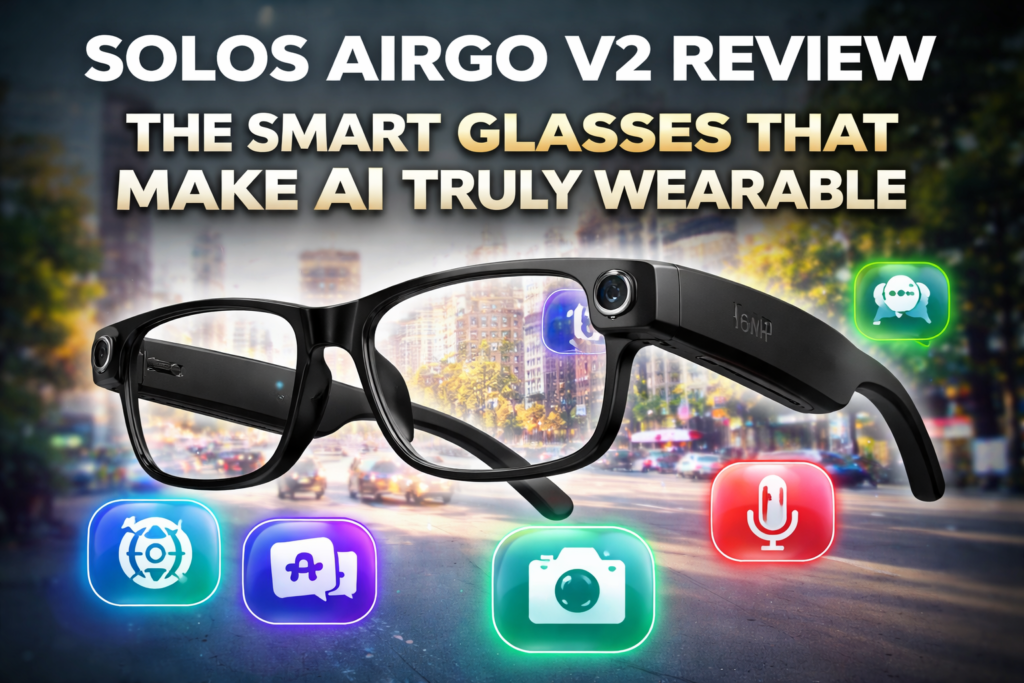
One of the first things you’ll notice about the AirGo V2 is how unobtrusive it feels compared with many other smart glasses. It doesn’t try to cram large displays or bulky sensors into the frame — instead, it aims for a look close to normal eyewear, with most tech tucked neatly into the arms. This approach strikes a good balance between wearability and functionality.
The glasses weigh roughly in the low-40-gram range depending on frame choice, which makes them comfortable for longer wear. The SmartHinge modular design lets you swap out frame fronts for different styles — including a non-camera version for situations where discretion matters. The glasses also include enhanced directional audio with built-in speakers that deliver clear sound with minimal leakage.
Camera & Visual Tech: Practical, Not Spectacular
The AirGo V2’s headline hardware upgrade over its predecessor is its ultra-slim 16 MP camera with electronic image stabilization (EIS). This isn’t just for snapshots — it’s the visual input that powers much of the AI functionality. The stabilization makes POV video surprisingly smooth, even when you’re moving, and the built-in low-power Wi-Fi enables live streaming directly from the glasses — a rare feature in this segment.
However, it’s important to temper expectations: there’s no AR display overlay in your field of vision; all interaction with AI and feedback comes via audio and voice. That’s great for keeping things light and wearable, but if you’re looking for holographic AR visuals or head-up displays, this isn’t what you’re buying.
AI Capabilities: Hands-Free Multimodal Intelligence
Where the AirGo V2 truly shines is intelligent assistance. Powered by SolosChat 3.0, these glasses support multimodal AI interactions, meaning they can process voice, image, and video together. You can ask questions like “What’s this?” or “Translate that sign,” and the AI will respond conversationally — all without reaching for your phone.
What sets the V2 apart from some competitors is its open AI ecosystem: instead of being locked to one assistant, it can interface with ChatGPT, Claude, Gemini, and DeepSeek, giving users flexibility in their AI backend. This broad compatibility is still rare in wearables and gives the AirGo V2 a future-proof edge.
Even better, Solos has integrated voice-activation and natural, interruptible dialogue so you can have back-and-forth conversations with your AI without awkward phrase triggers.
Battery Life & Modularity: Smart Solutions to Wearable Limitations
Battery life remains one of the biggest challenges in wearable tech. Solos doesn’t solve it magically, but it cleverly sidesteps the problem with swappable battery arms. If you’re out all day and the charge is running low, you can literally swap out the temples like changing batteries — a feature few competitors offer.
At CES, Solos also previewed a portable charging case with an 1,100 mAh battery, letting you charge spare battery arms while wearing another set — essentially giving you multi-day power without needing to sit beside a wall socket. That’s a practical design decision, even if the accessory isn’t out yet.
What the AirGo V2 Gets Right
- Practical AI: Real hands-free assistance that feels genuinely useful.
- Live streaming & stabilized video capture: Rare capability in this price bracket.
- Modular batteries and frames: Helps with longevity and customization.
- Open AI integration: Supports multiple assistant platforms.
Limitations to Consider
- No AR visual overlay: Interaction is audio/voice only.
- Mixed user experiences: Some early users of previous models reported setup difficulties. (Note: this applies to older generations and may not fully reflect V2.)
- Battery accessories not included: The charging case is separate and launches later.
Conclusion: A Smart Wearable with Real Purpose
The AirGo V2 doesn’t aim for sci-fi AR spectacle — instead, it focuses on functionality, modularity, and genuinely useful AI. At its price point and feature set, it’s one of the most compelling smart glasses for everyday assistance, content capture, and hands-free intelligence outside your smartphone. If that aligns with what you want from wearable tech, the AirGo V2 is a strong choice in 2026.